How to search for Ukrainian names in all their forms
Ukrainian names change their endings. One news item can open with «Тарас Дзвонарчук заявив» («Taras Dzvonarchuk said»), quote him as «за словами Тараса Дзвонарчука» («according to Taras Dzvonarchuk») and end with «подякували Дзвонарчукові» («thanked Dzvonarchuk»). A query that knows only the nominative can miss most of those mentions. This guide shows how to set up a MediaMonitor query that catches the forms you need and leaves out the noise. Тарас Дзвонарчук is a fictional person, invented for the examples in this article.
The three lists of a query
A query is three plain lists, with one word or phrase per line:
- Any of these words or phrases: a publication matches when it contains at least one of them. The name and all its variants go here.
- All of these: each of them must appear as well. Use it for context that has to be present, such as the name of the company the person runs.
- None of these: a publication that contains any of them is skipped.
Do not put quotation marks around a line: they are not supported, and a query with them is rejected. A line with several words is already a phrase, as described below.
Morphology, Exact or Case sensitive
Every query has one match mode, and it applies to every line in all three lists:
- Morphology (the default) also finds other forms of a word. For Ukrainian it uses a dictionary: each word of the query and each word of a publication is reduced to its dictionary form before they are compared. «Петренка» becomes «Петренко», so a query for one form finds the others. Russian and English words are reduced by stemming, which trims endings by rule instead of looking them up.
- Exact finds the word as you typed it, in any letter case.
- Case sensitive also requires the same capital letters. It helps when a name is also an ordinary word, although a common word at the start of a sentence is capitalised too.
The Language setting is used only with Morphology. All languages checks Ukrainian, Russian and English together; pick one language when you know what you are looking for. For Exact and Case sensitive, keep All languages.
If you need two modes, for example Morphology for a person's name and Exact for a short brand name, create two queries in the same project.
What the dictionary does not know
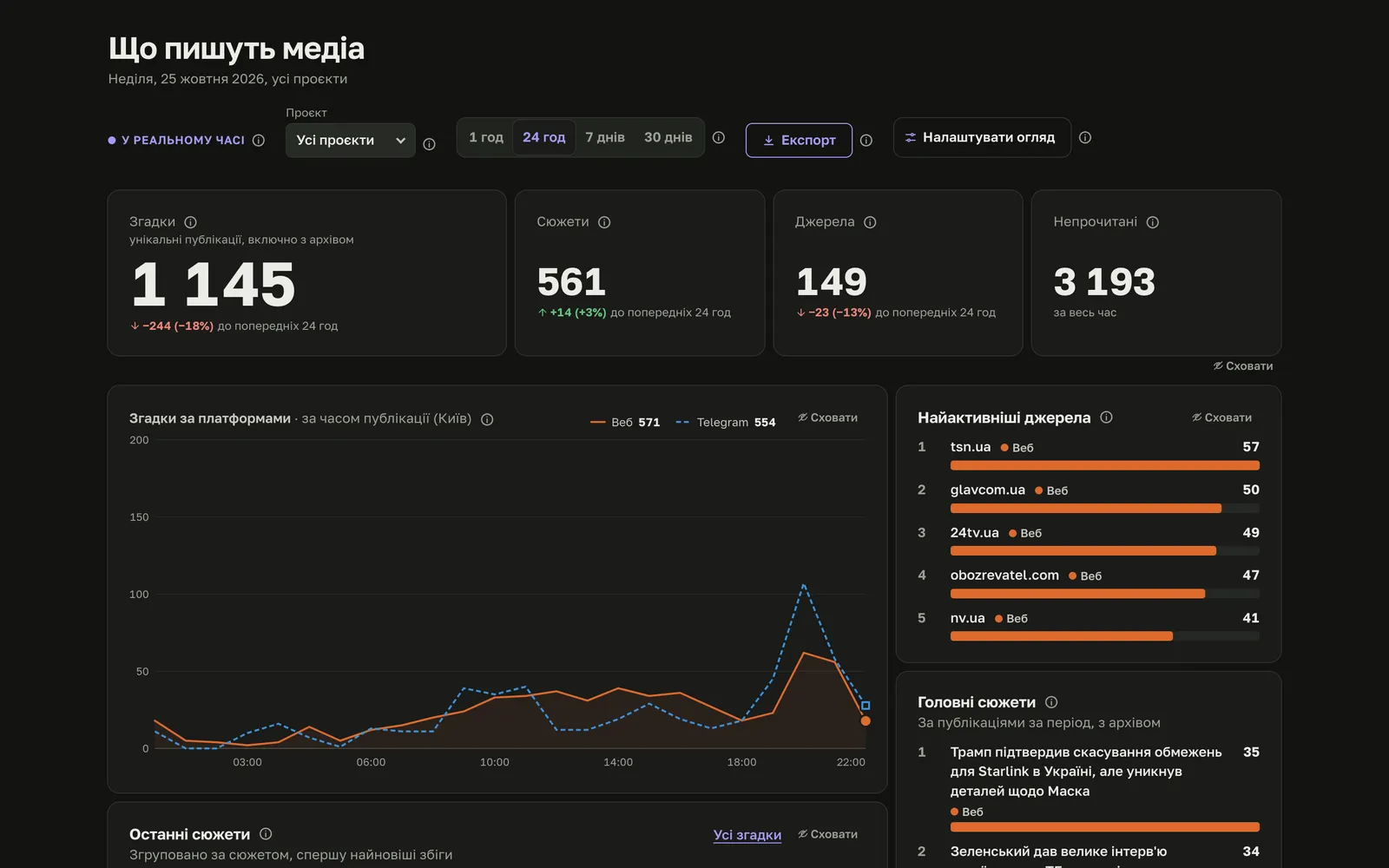
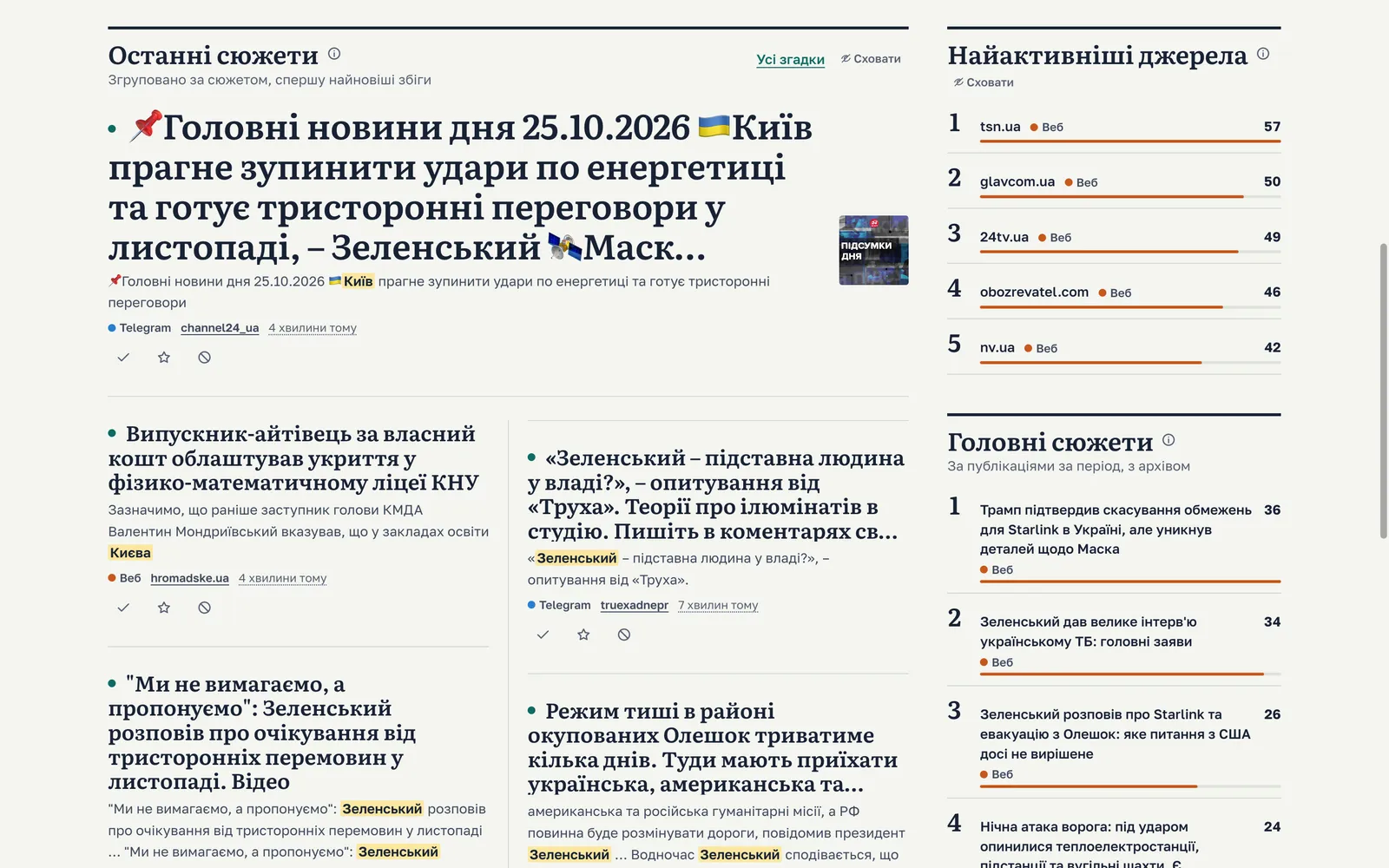
Morphology helps only with words that are in the dictionary. A common surname such as Петренко is there; a rare surname may not be. A dictionary can also read one word two ways: «Київ» is both the city and a form of «кий». Such words can bring in unrelated texts, so check the first results of a new query.
To check whether the dictionary knows a name, type only the nominative and save the query. A new or changed query also searches the recent archive. Look at the highlighted fragments: if the archive brings in «Дзвонарчука» and «Дзвонарчуком» as well, the dictionary knows the name. Archive finds arrive already marked as read and send no alerts, so the check does not flood the team with old news. New mentions that the active query finds from then on send alerts as usual.
Listing the forms yourself
When a name is not in the dictionary, list its forms. For our fictional Тарас Дзвонарчук, the Any of these list would be:
- Дзвонарчук
- Дзвонарчука
- Дзвонарчукові
- Дзвонарчуку
- Дзвонарчуком
Five lines cover all seven cases: «Дзвонарчука» serves as the genitive and the accusative, and «Дзвонарчукові» and «Дзвонарчуку» cover the dative and the locative, with «Дзвонарчуку» also used as the vocative. Put such a list in a query with Exact matching: it finds each form exactly as typed, whatever the dictionary contains.
Keep the grammar of the name in mind. A woman's surname that ends in a consonant does not change: Оксана Дзвонарчук stays «Дзвонарчук» in every case, while her first name still changes («Оксани», «Оксані», «Оксаною»). For her, the surname alone is one line, but a phrase with her first name needs those forms.
Spelling variants: Cyrillic, Latin, Ukrainian and Russian
Morphology connects the forms of one word. It does not connect different spellings. For the search, Зеленський, Зеленский, Zelensky and Zelenskyy are four different words, so a query about the president lists each of them on its own line. The same applies to any name that Russian-language channels or English-language sites spell their own way.
For our fictional person, the list would grow with «Звонарчук», a spelling Russian-language sources might use, and «Dzvonarchuk» in Latin letters. In an Exact query, the Russian spelling needs its own forms as well: «Звонарчука», «Звонарчуку», «Звонарчуком», «Звонарчуке». When a Latin name has more than one transliteration in use, add each one you have seen.
Several words on one line
A line with a space, such as «Тарас Дзвонарчук», is a phrase. The words may come in either order, with up to two other words between them. The line therefore also finds «Дзвонарчук Тарас» and «Тарас Іванович Дзвонарчук».
A full-name line is much stricter than the surname alone. It skips a namesake with another first name, but it also skips a text that names the person by surname only. In an Exact query, every word of the phrase must also be in the form you typed, so «Тарас Дзвонарчук» there does not find «Тараса Дзвонарчука». For a rare surname, the list of surname forms is usually the safer choice; for a common one, the full name avoids a flood of namesakes.
Excluding namesakes and noise with None of these
MediaMonitor does not tell namesakes apart by itself. If a footballer shares the surname of the person you follow, add words from his context to None of these, for example «футбол», «матч», «гол». In an Exact query these words, too, match only in the form you typed, so add the forms you see, such as «матчу» and «матчі». Any publication that contains one of them is skipped, even when it is also about your person. Keep the list short and specific, and look at what the query finds before you add more words.
The example, put together
| Setting | Value |
|---|---|
| Any of these words or phrases | Дзвонарчук, Дзвонарчука, Дзвонарчукові, Дзвонарчуку, Дзвонарчуком, Звонарчук, Звонарчука, Звонарчуку, Звонарчуком, Звонарчуке, Dzvonarchuk (one per line) |
| All of these | empty, or the name of the person's company if the surname turns out to be shared |
| None of these | футбол, футболу, матч, матчу, матчі (one per line), added only after namesakes appear |
| Match | Exact |
| Language | All languages |
A short checklist
- Start with the nominative and Morphology, and see what the archive search brings in.
- If other forms do not appear, list them yourself in a query with Exact matching.
- Add every spelling you meet: Ukrainian, Russian and Latin.
- Use a full-name phrase when the surname is common.
- Add None of these words only for namesakes you have actually seen.
To try this on your own names, start with MediaMonitor.