Google Alerts
and MediaMonitor:
what each one does
Google Alerts e-mails you when Google Search finds new results for a topic. MediaMonitor watches news sites and public Telegram channels for a team. Here is what each one does, with Google's side taken only from Google's own pages.
Verified on
Prepared by the MediaMonitor team
For Google Alerts we used only Google's own pages:
- The Google Alerts help page support.google.com
- The Google Alerts form google.com/alerts
Google can change its service at any time. Where its pages say nothing, we write Unknown rather than guess.
Side by side
Google's column repeats only what its help page and its Alerts form state. Unknown means its pages do not document it, not that the feature is missing.
| Criterion | Google Alerts | MediaMonitor |
|---|---|---|
| What is searched |
New results in Google Search. Source types to choose from: Automatic, News, Blogs, Web, Video, Books, Discussions, Finance. |
News websites and public Telegram channels from the MediaMonitor catalogue. |
| Telegram channels |
UnknownNeither page mentions them. |
Yes: the public channels in the catalogue. |
| How often |
As it happens, at most once a day, or at most once a week. |
Continuously. Telegram posts usually arrive within seconds, news sites usually within minutes. |
| Delivery |
E-mail, the method its help page describes. UnknownAn RSS feed is not described on either page. |
The dashboard, e-mail, one Telegram chat per workspace, webhooks signed with HMAC-SHA256, and Excel export. |
| Languages and regions |
About 45 languages, Ukrainian and Russian among them, and about 240 countries and territories. |
Queries in Ukrainian, Russian and English. Ukrainian word forms are matched with a dictionary, Russian and English by stemming. Queries have no region setting. |
| How many results |
Only the best results, or all results. |
Every match of your queries in the catalogue. |
| Duplicates |
UnknownNot documented. |
Reprints are grouped into stories automatically, by text similarity. Grouping is not perfect, so a story always lists every publication in it. |
| Team |
An option for which accounts get the alert. UnknownA shared workflow is not documented. |
A workspace with members, roles and shared marks: new, read, important, irrelevant. |
| History |
UnknownNot documented. |
A new query checks the last 30 days, up to its 1,000 latest matches. |
From an alert to a project
If you already follow a topic with Google Alerts, this is how the same topic runs in MediaMonitor.
-
Take the words you watch
Move the names, brands or phrases from your alert into a project. A project holds the queries for one person, brand or topic.
-
Write them as a query
Put each word or phrase on its own line in one of three lists: any, all or none. A line of several words finds them close together, in any order. In the Morphology match mode, the default, other forms of Ukrainian words in its dictionary match too; for a rare name, list its forms yourself.
-
See recent matches straight away
Saving the query checks the last 30 days of what we have collected, up to its 1,000 latest matches. These archive finds arrive marked as read and send no alerts. New publications follow as they appear, grouped into stories.
-
Decide who hears about it
Choose which members get e-mail alerts and add one Telegram chat for the workspace. With reprints collapsed, a story sends one alert, not one per reprint. Signed webhooks and Excel export take the finds into your own systems. When someone marks a find important or irrelevant, the whole team sees it.
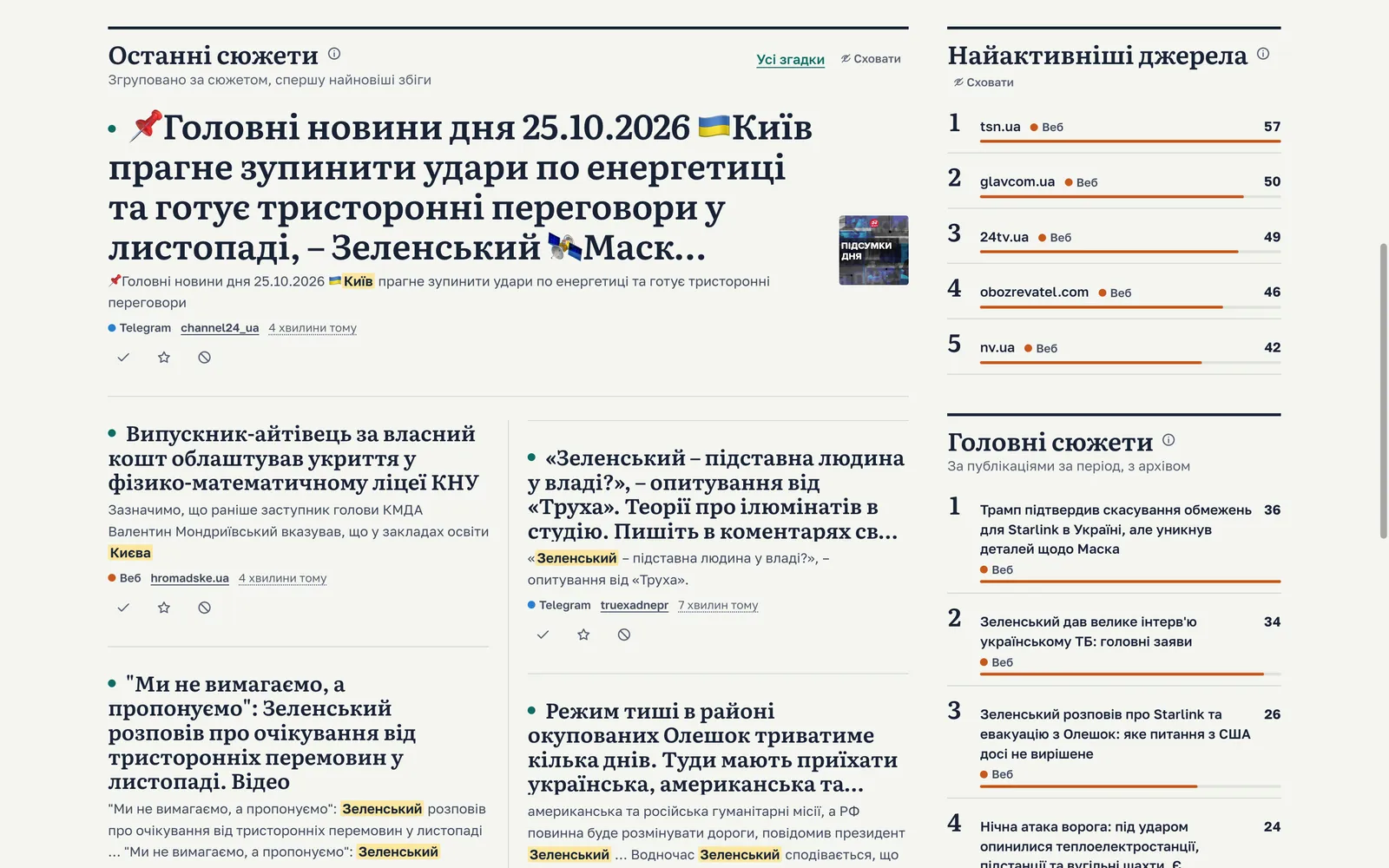
Which one for which job
The two do different jobs, and nothing stops you from running both.
Google Alerts suits
- Broad watching of the open web: news, blogs, video, books, discussions and more
- Many languages and regions, set in one form
- New results by e-mail, as they happen, daily or weekly
MediaMonitor suits
- Ukrainian media and public Telegram channels in one feed
- A team in one workspace, with roles and shared marks
- Fewer duplicates to read: reprints grouped into stories
- Taking finds into your own systems: signed webhooks and Excel export
MediaMonitor sees only the sources in its catalogue: news websites and public Telegram channels. Facebook, Instagram, X and other social networks are not monitored.
Compare them on one topic
Create an account, write a query for a topic you already follow, and see what arrives.
Create an account