Telegram monitoring
and news sites

MediaMonitor reads the public Telegram channels and news sites in its catalogue, finds the posts and articles about the person, organisation or topic you follow, and shows both in one feed, with reprints grouped into stories.
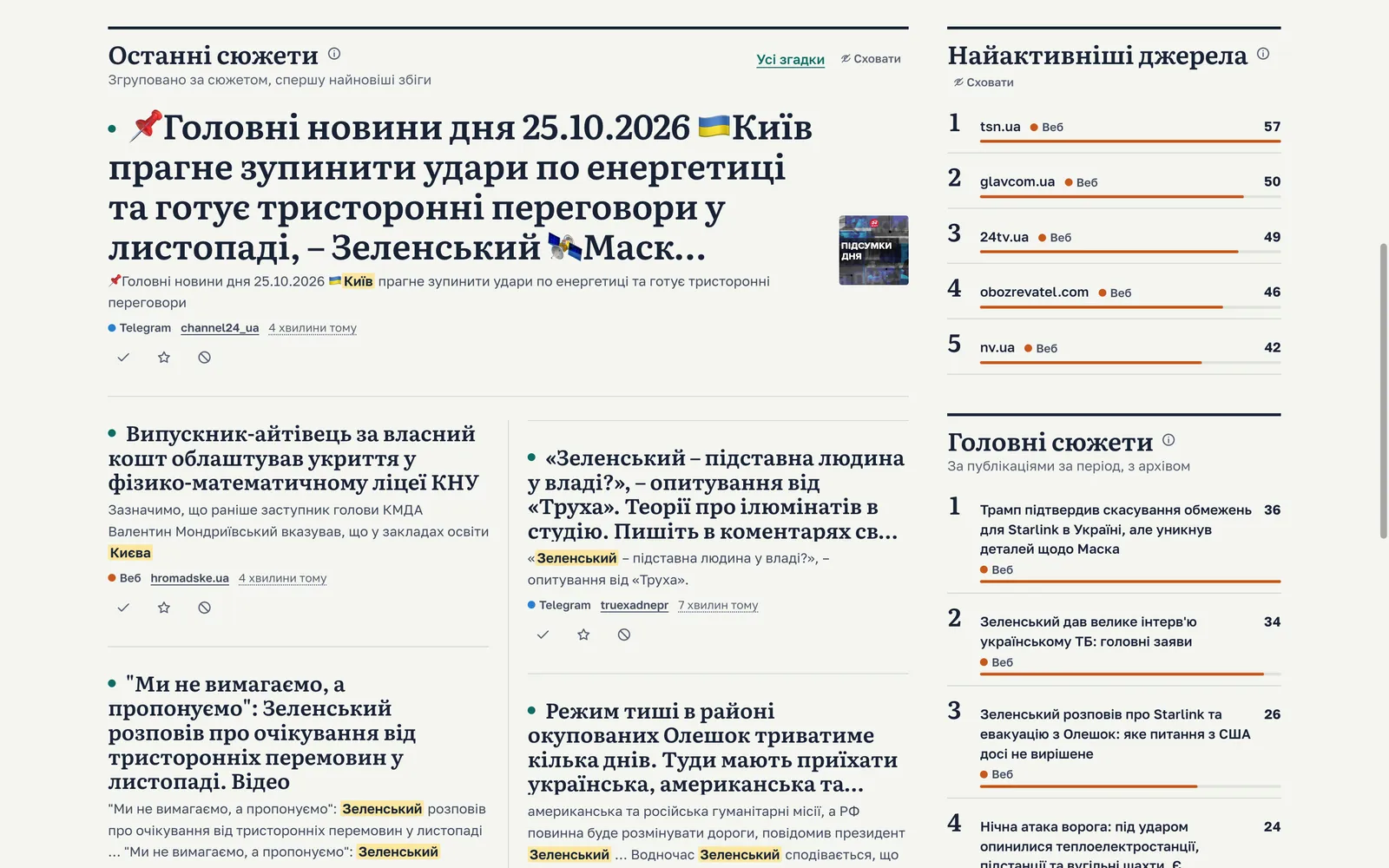
Latest stories in the cabinet: the words a query matched are highlighted, each story has Read, Important and Irrelevant buttons, and the most active sources are listed beside them
Latest stories

A real screen with live data, 25 October 2026.

What you can follow

Set up a project for whatever you answer for. These are the tasks it is built for.

  • A person

    A minister, a company head, a spokesperson: posts and articles that name them.

  • An organisation or a brand

    Its name, its products and its people, in channels and on sites at once.

  • A topic

    A bill, a tender, a strike, a problem in your city: the publications in the catalogue that have your words.

  • Who carried it

    For each story, which channels and sites published it and which one was first.

What we read

MediaMonitor reads its own catalogue of sources: the public Telegram channels and news sites it collects. Monitoring covers that catalogue, not the whole of Telegram.

  • Public Telegram channels

    Posts from the channels in the catalogue, with their text and first photo. A post has no headline, so its first words stand in for one.

  • News sites

    Articles from the sites in the catalogue, with their headline and lead.

What we do not read

  • Private chats, closed groups and personal messages
  • Channels and sites outside the catalogue
  • Other social networks: Facebook, Instagram, X, TikTok, YouTube

Missing a channel or a site you need? Send its link to support: [email protected]. We will look at it, but we cannot promise to add every source. How the catalogue is built

Queries with word forms

A query is three lists, one word or phrase per line. Morphology, the default, matches Ukrainian words in the forms its dictionary knows; Russian and English words are matched by their stems.

An illustration of a query, not a screenshot.

How the lines are read

  • Any of these: a publication needs at least one. All of these: it needs each of them as well. None of these: a publication with any of them is skipped.
  • A line of several words is a phrase. Its words may come in either order, with up to two other words between them: «Ігор Петренко» also finds «Петренко Ігор».
  • Morphology finds the other forms of a Ukrainian word that its dictionary has. A rare surname or a new brand may be missing: put the forms you expect on separate lines.
  • Each spelling is a different word. Зеленський, Зеленский and Zelensky go on three lines.
  • Exact finds the word as typed, in any letter case. Case sensitive also needs the same capital letters, which helps when a name is also an ordinary word.
  • One language and one match mode apply to the whole query. All languages checks Ukrainian, Russian and English; a single language works only with Morphology.

Reprints, one story

Channels pick up each other’s posts and sites rewrite them. MediaMonitor groups the publications about one event by how close their texts are.

  1. 24tv.ua

    Перехід на зимовий час 2026: скільки днів залишилося до переведення годинників

    First publication

  2. @te20hvylyn

    Перехід на зимовий час 2026 року: коли переводять годинники

  3. hromadske.ua

    У ніч на 25 жовтня Україна перейде на зимовий час

  4. @khmel_informue

    В ніч проти 25 жовтня Україна перейде на зимовий час: стрілки переводять на годину назад

    Same text

  5. @vinnytsia_informue

    В ніч проти 25 жовтня Україна перейде на зимовий час: стрілки переводять на годину назад

    Same text

Story: Перехід на зимовий час

129 publications 107 sources

Web Telegram A real story from the MediaMonitor stream, 23–25 October 2026.
  • First publication The earliest publication in the story.
  • Same text A copy of the same text, or of nearly the same text.
  • Similar wording Another text about the same event, worded differently but close in meaning.

Grouping is not perfect. Two reports of one event can stay apart, and a short post joins a story only when its text is the same. Each project has the switch Collapse reprints into one story, on by default: a story then sends one alert and one webhook, for its first mention, and later reprints still appear in the feed.

Speed and history

  • Telegram

    A post usually reaches the feed seconds after it is published.

  • News sites

    An article usually arrives within minutes, when its site is next crawled.

  • Before you started

    A new query also searches the last 30 days of the archive, up to its 1000 latest matches. Changing a query or turning it back on searches again.

    Finds from the archive arrive already read and send no alerts.

    Search reaches back as far as the archive: this month and the 2 before it.

From feed to team

New mentions can reach the people who need them, and the team works through the feed together.

Alerts

  • E-mail: to all members of the workspace or only the ones you select, with the matched passages and a link to the publication.
  • Telegram: to one chat for the whole workspace, such as your team’s group: add our bot to it and enter the chat’s ID in the workspace settings.
  • Webhooks: signed JSON (HMAC-SHA256) for each new mention, to up to 10 HTTPS endpoints per project, retried if delivery fails.

In the feed

  • Open a story to see who published first and the other publications your queries found in it.
  • Mark a mention Read, Important or Irrelevant: the label is shared with the whole team.
  • Export publications, matches, stories and sources to Excel for a report.

Limits to know

  • Coverage is the catalogue. A channel or site outside it is not monitored, and a suggested source may not be added.
  • Only public channels and news sites: private chats, closed groups and other social networks are not read.
  • Morphology depends on the dictionary. Rare names need their forms listed, and every spelling or transliteration needs its own line.
  • Grouping is automatic and not perfect: open the story when it matters.
  • History is limited: 30 days and up to 1000 matches for a new query, and nothing older than the archive keeps.
  • MediaMonitor finds and groups publications; it does not rate their tone.

Start with one name

Create an account, add a project for the name or topic you follow, and see what channels and sites have written about it over the last 30 days.

Create an account